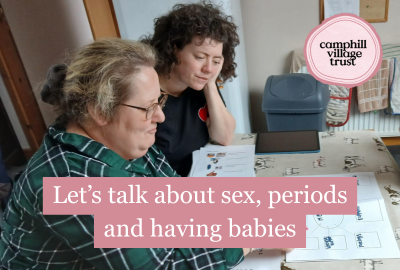
Conversations about sex, relationships, periods, and having children are often avoided when it comes to adults with learning disabilities. Yet these topics are a vital part of living an independent, fulfilled life.
Recently, researchers Kirsty from Inclusion North and Rachael from Lancaster University visited as part of Swept Under the Carpet: Let’s talk about sex, periods, and having babies, a project organised in partnership with Ace Anglia, University of East Anglia, Essex University funded by the National Institute of Health and Care Research (NIHR), to share more about their work.
Why these conversations matter
For adults with learning disabilities, access to information about relationships, intimacy, and choice is frequently limited. This lack of open discussion can create significant barriers to independence and wellbeing.
Only around 3% of people with a learning disability live as a couple, compared with around 70% of the general population. This stark difference highlights the many social, cultural, and systemic obstacles that still exist — from assumptions about capacity to a lack of accessible education and support.
Challenging taboos and inequalities
These conversations are especially important because adults with learning disabilities experience significant health inequalities. Sex, relationships, and reproductive health are still widely treated as taboo, and many people with learning disabilities rarely get the chance to talk openly about these issues.
Projects like Swept Under the Carpet help to challenge this silence; creating space for learning, discussion, and reflection, while recognising that everyone has the right to information, choice, and dignity.
Kirsty explains:
“SUTC is important because everyone is different. Talking about sex, relationships, and having babies isn’t often heard of for people with learning disabilities, even though it’s a human right. With this project, we want to change that. Sometimes services forget how capable people are, even if they have a learning disability.”
Looking ahead
By continuing to support open, inclusive conversations around relationships and reproductive health, projects like Swept Under the Carpet play an important role in challenging stigma and reducing inequality.
Thank you to Kirsty, Rachael, and the Swept Under the Carpet team for helping to shine a light on these important, and often overlooked, conversations.