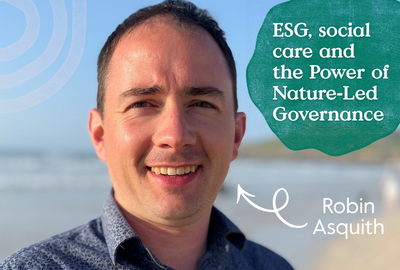
Hear from Robin Asquith, Head of the Natural Environment, who recently attended a roundtable in London to discuss all things ESG (environmental, social and governance) and social care…
I recently had the privilege of visiting the Supreme Court. Thankfully, it wasn’t for anything ominous. I’d been invited to represent the Trust at a roundtable on embedding ESG into social care. ESG, environmental, social and governance, is essentially a way of understanding how organisations behave: how they look after the planet, how they treat people, and how well they’re run. In social care, where people’s lives are shaped by leadership, buildings, culture and care, ESG isn’t a corporate extra. It’s the backbone of long‑term resilience.
ESG is often framed around the three Ps: people, planet and profit. Someone at the roundtable suggested adding two more- people power and presence. In social care, that rings true. The social care workforce is huge, and the voices of the people we support are even bigger if they’re given the power to use them and others have the presence to listen. It links straight back to Section 1 of the Care Act: what people can do and can be. Language matters here. Terms like ‘care package’ creep in and dehumanise. People aren’t parcels; they’re individuals with identity and aspirations.
The roundtable brought together a proper cross‑section of the sector, which made for a grounded and honest discussion. One theme kept resurfacing: Whitehall listens to the NHS, but social care is still treated as the poor cousin. This is despite social care workers quietly taking on more and more of the NHS’s workload, delivering services that once sat firmly on the health side of the fence. Yet society still expects this to be done on minimum wage. There remains a deep misunderstanding in policymaking circles about what good social care looks like, and what it takes to deliver it safely and with dignity.
At the Trust, we want to reimagine social care through the lens of nature. ESG fits naturally into that, not just the environmental bit, but the social and governance elements too. Take energy. Care homes and community buildings use a lot of it, and we’ve all felt how global events can suddenly hit our bills. So how do providers build resilience while still delivering high‑quality, well led services?
Part of the answer lies in our buildings. Many of ours are shaped by anthroposophical design principles: natural light, views of green space, materials that breathe. These aren’t luxuries; they’re proven to lift mood, reduce stress and support wellbeing. We use a lot of timber and insulation, and we were early adopters of solar panels and energy‑efficient construction. We’ve seen the benefits in reduced energy costs and calmer environments, but there’s still more to do.
The Government’s new Land Use Framework is a welcome step towards a more grown‑up conversation about how we use land. Those of us in rural settings have long known that land can and should do more than one job at once. Food, nature, climate resilience, community wellbeing: with the right approach, they strengthen each other.
That’s exactly where social farming sits. Social farms already deliver the multifunctional land use that the Land Use Framework champions. They produce food, restore landscapes, and give people a place to belong, learn and rebuild confidence. They’re practical, relational, rooted in place, and they offer a model of rural enterprise that’s both economically resilient and socially purposeful.
Seen through an ESG lens, the alignment is even clearer. Social farming strengthens the environmental pillar through regenerative practices. It drives the social pillar by improving health, reducing isolation and creating meaningful roles. And it supports governance, not just through policies, but through how people interact with them.
Good governance has two sides: the systems and the behaviours that bring them to life. Culture is the real test. It isn’t built by freebies or slogans. It shows up when someone makes a mistake, when a safeguarding concern is raised, or when a tough decision needs to be made and no one is watching. Those moments reveal whether values are lived or not. Posters don’t build culture, behaviour does. The distance between the words and the actions is where governance is either strengthened or undermined.
That’s why designing committee Terms of Reference, agendas and paper cover sheets to reference values and ESG principles is so important. If every meeting asks, ‘What does this mean for our values? What does this mean for ESG?’, it becomes part of the organisational bloodstream.
‘Well‑led’ should also be a standing agenda item. The CQC’s framework is heavy on culture, values and leadership. It asks hard questions about impact, not just compliance. Governance only becomes credible when values are measurable, reportable and challengeable. That’s how you shift from compliance to culture, from words to evidence, from aspiration to accountability.
The Land Use Framework also opens the door to more intelligent commissioning. It could help local services identify where land‑based interventions can deliver the greatest social and environmental return. Integrated Care Systems talk endlessly about prevention; social farming is one of the few places where prevention is already happening.
Environmental awareness can also support staff beyond the workplace. Simple training on reducing boiler use, washing differently or cutting waste can save people money at home. In a low‑paid sector, that matters. ESG shouldn’t be something done to staff; it should strengthen them.
ESG strategies also need to be co‑developed with the people we support. One simple idea: make nature a standing agenda item in meetings. It shifts thinking. It holds people to account.
And finally, a thorny point: why do staff struggle to buy into ESG when funding appears available? Because from their perspective, money is being spent on ‘ESG projects’ while they’re making difficult choices due to low pay. ESG must include fair reward, safe staffing and working environments that respect dignity. If ESG is to mean anything in social care, it has to improve the lives of the people delivering the care, as much as the people receiving it.